

Patents for November 2026
Patents for November 2026 as compile by the editors of WCTI from the USPTO.
Low-Profile Cable Armor
US Patent 12,770,757
Published October 20, 2026
Inventors: Peter Lafreniere, Mattapoisett, MA, USA; Stephen Lundgren, Marion, MA, USA; Paulo Damoura, Dorchester, MA, USA; Ronald Pegg, New Bedford, MA, USA; Antonio Araujo, New Bedford, MA, USA; and David Campbell, Bristol, RI, USA
Assignee: AFC Cable Systems, Inc., New Bedford, MA, USA
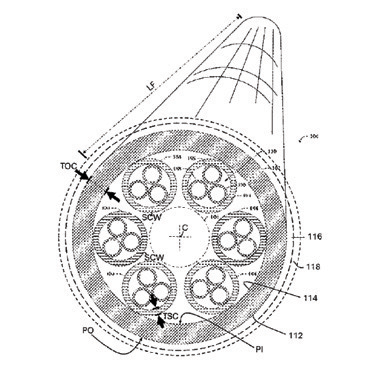
Disclosed is an armored cable assembly which may include a plurality of conductors and a metal sheath disposed over the plurality of conductors. The metal sheath may have a plurality of revolutions extending helically along a lengthwise axis, each of the plurality of revolutions including a first section having a curved profile, a second section extending from the first section, the second section having a planar profile and a third section extending from the second section. The third section may include a free end angled towards an interior cavity of the metal sheath, the free end extending past a plane defined by a bottommost point of the first section of an adjacent revolution, the plane extending perpendicular to the second section.
Systems, Devices, and Methods for Wire Harness Manufacturing
US Patent 12,763,538
Published October 13, 2026
Inventors: Nam D. Tran, Fort Worth, TX, USA; and Michael Janney, Fort Worth, TX, USA
Assignee: Interconnect Wiring, L.L.P., Fort Worth, TX, USA
A connector and wire connecting system may include an induction heater including an induction coil having a first terminal and a second terminal. The induction coil may be configured in a manner that an electric current flows through the induction coil from the first terminal to the second terminal, the electric current creating an electromagnetic field adjacent to the induction coil forming a heating zone. A wafer holder may be configured to support a multi-socket connector and a plurality of wires along a linear interface, each wire of the plurality of wires being independently connectable to a respective socket of the multi-socket connector, the interface being placeable within the heating zone. The induction coil may be disposed relative to the wafer holder and configured to heat the interface between the multi-socket connector and the plurality of wires within the heating zone.
Reinforced Protection Micro-Bunched Cable and Manufacturing Process Thereof
US Patent 12,761,435
Published October 13, 2026
Inventors: Wei Cai, Jiangsu, China; Xiaoming Miao, Jiangsu, China; Juan Zhou, Jiangsu, China; Lingzhi Zhu, Jiangsu, China; Huihui Qian, Jiangsu, China; Liang Liu, Jiangsu, China; Yafu Miao, Jiangsu, China; and Yujie Feng, Jiangsu, China
Assignee: Jiangsu Zhongtian Technology Co., Ltd., Jiangsu, China
This application belongs to the field of optical cables and provides a reinforced protection micro-bunched cable and a manufacturing process thereof. The reinforced protection micro-bunched cable includes reinforced protection micro-bunched tubes; the outer surface of the reinforced protection micro-bunched tube is arranged with bumps and there is a gap between bumps. The thickness of the micro-bunched tube wall at the gap between the bumps is still small, and the bump material is softer than the tube body material. The thickness of the micro-bunched tube wall at the gap between the bumps is still small, which can meet the construction requirements of easiness for stripping; the bump can effectively buffer the external force; further, the added bumps can increase the longitudinal tensile properties of the whole tube, and the tube was not easy to be broken under tension.
Insulated Electric Wire and Manufacturing Method of Insulated Electric Wire
US Patent 12,763,231
Published October 13, 2026
Inventors: Hideyuki Suzuki, Tokyo, Japan; Naoto Teraki, Tokyo, Japan; Masamichi Kishi, Tokyo, Japan; Seiichi Kashimura, Tokyo, Japan; Kazufumi Suenaga, Tokyo, Japan; and Kanako Suganuma, Tokyo, Japan
Assignee: Proterial, Ltd., Tokyo, Japan
An insulated electric wire is provided with a metal conductor and an insulation coating layer covering an outer periphery of the metal conductor. The insulation coating layer includes a lubricant layer including fluorine-based fine particles as a lubricant as an outermost layer and an enamel insulation layer including fluorine-based fine particles as an inner layer with respect to the lubricant layer.
Self-Passivating Material Communication Cable System
US Patent 12,763,534
Published October 13, 2026
Inventor: Gary E. Mastenbrook, Ann Arbor, MI, USA
Assignee: Northrop Grumman Systems Corporation, Falls Church, VA, USA
In a described example, a cable can include a first conductor, a second conductor and an offset structure. The first conductor can be formed to include a first self-passivating metal. The second conductor can be formed to include a second self-passivating metal. The offset structure can be disposed between the first conductor and the second conductor. The offset structure can be configured to enable a medium to contact the first conductor and the second conductor along a length of the cable. Further, a cable connection system can include the cable, a first connector and a second connector.
Portable Wire Stripping and Crimping Machine
US Patent 12,763,540
Published October 13, 2026
Inventor: Jhih-Sian Jheng, Taichung, Taiwan
Assignee: Yuan Cheng Automatic Control Co., Ltd., Taichung, Taiwan
A portable wire stripping and crimping machine, comprising: a base having a housing and an operation front. On the base, from left to right of the operation front, a feeding module, a wire stripping module, a crimping module and an insulation stripping module are provided, respectively, the crimping module being connected to the feeding module and its bottom side being connected to the wire stripping module; and an operation control module having multiple switch buttons provided on a control side connected to the operation front. The crimping module consists of a first motor reducer, a toggle mechanism and a crimping mechanism. The wire stripping module consists of a second motor reducer, a wire clamping mechanism and a die cutter mechanism. The insulation stripping module consists of a third motor reducer and an insulation stripping mechanism.
High Density, Low Diameter Cable with Rollable Fiber Optic Ribbon
US Patent 12,754,388
Published October 6, 2026
Inventors: Gerhard Merbach, Neustadt bei Coburg, Germany; and Sebastian Olszewski, Lodz, Poland
Assignee: Corning Research & Development Corporation, Corning, NY, USA
A high density, low diameter optical fiber ribbon cable is provided. The cable includes a polymeric outer cable jacket and a plurality of flexible optical fiber ribbons. The cable includes a relatively high number of optical fibers despite a relatively small outer diameter. The flexible optical fiber ribbons are located within the cable jacket without buffer tubes, central strength elements and/or gel materials.
Fiber Optic Cable
US Patent 12,754,387
Published October 6, 2026
Inventors: Yusuke Yamada, Musashino, Japan; and Kazuhide Nakajima, Musashino, Japan
Assignee: NTT, Inc., Tokyo, Japan
An object of the present invention is to ensure low crosstalk for all multi-core optical fibers in an optical fiber cable having a plurality of identical multi-core optical fibers of non-coupling type in different spiral shapes. An optical fiber cable according to the present disclosure is an optical fiber cable formed by twisting a plurality of units each of which is formed by bundling a plurality of identical multi-core optical fibers of non-coupling type, which includes: that all the units have the same diameter; that the units are arranged in a plurality of layers from a center in a cross section; that the units are arranged in a spiral shape for each of the layers in a longitudinal direction; that all the units included in one of the layers have the same twist pitch of the spiral shape; and that the twist pitch is different for each layer, and is set based on a curvature Rpk of the multi-core optical fiber where crosstalk is the largest.
Process for Producing Cable with Insulation Layer
US Patent 12,755,874
Published October 6, 2026
Inventors: Yabin Sun, Shanghai, China; Gaoxiang Wu, Lake Jackson, TX, USA; Colin LiPiShan, Lake Jackson, TX, USA; Timothy J. Person, Collegeville, PA, USA; Wenxin Zhang, Shanghai, China; Kainan Zhang, Shanghai, China; and Jie Ji, Shanghai, China
Assignees: Dow Global Technologies LLC, Midland, MI, USA; and Dow Silicones Corporation, Midland, MI, USA
The present disclosure provides a process. In an embodiment, the process includes providing an initial cable core. The initial cable core includes (i) a conductor and (ii) an initial insulation layer. The initial insulation layer includes a crosslinkable polymeric composition composed of (a) an ethylene-based polymer composed of (1) ethylene monomer, (2) an optional α-olefin comonomer, and (3) an optional organosiloxane comonomer. The crosslinkable polymeric composition further includes (b) dicumyl peroxide (DCP), (c) an Si—H containing (AP) scavenger, (d) optional curing coagent, and (e) optional anti-oxidant. The process includes subjecting the initial cable core to a crosslinking procedure sufficient to crosslink the crosslinkable polymeric composition and form a cable core with a crosslinked insulation layer.
Cable with Abnormality Sign Detection Function and Wire Abnormality Sign Detection System
US Patent 12,755,864
Published October 6, 2026
Inventors: Hirokazu Komori, Yokkaichi, Japan; Takahiro Murata, Yokkaichi, Japan; Fujio Sonoda, Osaka, Japan; Masato Izawa, Osaka, Japan; and Takumi Ooshima, Kanuma, Japan
Assignees: Autonetworks Technologies, Ltd., Mie, Japan; Sumitomo Wiring Systems, Ltd., Mie, Japan; and Sumitomo Electric Industries, Ltd., Osaka, Japan
A cable with an abnormality sign detection function and a wire abnormality sign detection system that can perform stepwise detection of signs leading to breakage in a wire accurately. The cable contains a target wire containing a wire conductor and a wire covering that covers the conductor and a detection line containing a detection line conductor and a detection line covering that covers the detection line conductor, where the detection line conductor has a shorter flex life than the wire conductor and contains long-life elemental wires and short-life elemental wires having a shorter flex life than the long-life elemental wires, each of the long-life and short-life elemental wires containing a solid wire made of a conductive material and an insulation covering layer covering the solid wire, and in the detection line conductor, the short-life elemental wires are arranged in a layer around a bundle of the long-life elemental wires.
Cu—Ag Alloy Wire and Method for Producing the Same
US Patent 12,755,860
Published October 6, 2026
Inventors: Go Odachi, Kawasaki, Japan; Rikuya Watanabe, Kawasaki, Japan; and Ryuichi Arai, Kawasaki, Japan
Assignee: SWCC Corporation, Kawasaki, Japan
An object of the present invention is to provide a Cu—Ag alloy wire that has satisfactory hardness and specific resistance both suitable for probe pins. A Cu—Ag alloy wire that achieves the above object contains 0.1 to 30 mass % of Ag, with a remainder composed of Cu and unavoidable impurities. The Cu—Ag alloy wire has a Vickers hardness of 300 HV or more and a specific resistance of 3.0 μΩ·cm or less.
Cable Assembly for a Cable Connector Module
US Patent 12,756,120
Published October 6, 2026
Inventors: Bruce Allen Champion, Camp Hill, PA, USA; John Joseph Consoli, Harrisburg, PA, USA; and Chad William Morgan, Carneys Point, NJ, USA
Assignee: TE Connectivity Solutions GmbH, Schaffhausen, Switzerland
A cable assembly includes a cable having signal conductors and a cable shield surrounding an insulator. The cable assembly includes a ground clip coupled to the end of the cable having a support wall supporting the end of the cable. Exposed portions of the signal conductors extend through a window in the support wall. The ground clip includes connecting tines extending from the support wall to interface with upper and lower portions of the cable shield. The ground clip includes a mounting tab configured to be mounted to a circuit card to fix the ground clip relative to the circuit card and electrically connect the ground clip to the circuit card. The ground clip supports the cable such that the cable extends from the support wall in a cable exit direction angled transverse relative to a mounting surface of the circuit card.
Strength Member Assemblies and Overhead Electrical Cables Incorporating Optical Fibers
US Patent 12,749,596
Published September 29, 2026
Inventors: William Webb, Laguna Niguel, CA, USA; Xiaoyuan Dong, Johns Creek, GA, USA; Christopher Wong, Santa Ana, CA, USA; Ian M. Pilling, Rancho Santa Margarita, CA, USA; and Douglas A. Pilling, Bonita, CA, USA
Assignee: CTC Global Corporation, Irvine, CA, USA
Strength member assemblies including a strength member and at least one glass optical fiber operatively coupled to the strength member. The optical fiber is coupled to the strength member in a manner such that mechanical strains experienced by the strength member are transferred to the optical fiber so that the optical fiber may be interrogated to assess the state of the strength member.
Insulated Electrical Wire and Resin Composition
US Patent 12,749,592
Published September 29, 2026
Inventors: Takuma Maruhashi, Osaka, Japan; Koji Nakanishi, Osaka, Japan; Toyomitsu Seki, Osaka, Japan; and Hideki Kono, Osaka, Japan
Assignee: Daikin Industries, Ltd., Osaka, Japan
An insulated wire including a conductor (A) and an insulating layer (B) around the conductor (A). The insulating layer (B) contains an aromatic polyetherketone resin (I) and a fluorine-containing copolymer (II) and has a melt viscosity at 60 sec⁻¹ and 390°C of 0.40 to 0.75 kPa·s. The aromatic polyetherketone resin (I) has a melt viscosity at 60 sec⁻¹ and 390°C of 0.30 kPa·s or lower. The insulating layer (B) has a thickness of 30 to 300 μm.
Cable Harness Manufacturing System and a Kit of Parts and Tooling Components for Use with an Assembly Board in Cable Harness Manufacturing Applications
US Patent 12,749,599
Published September 29, 2026
Inventors: Nuno Carrolo, Lisbon, Portugal; João Bernardo Pires Afonso Bispo, Corroios, Portugal; Ricardo Tavares Correia Rosado, Lisbon, Portugal; and Pedro Matias, Lisbon, Portugal
Assignee: Aptiv Manufacturing Management Services GmbH, Schaffhausen, Switzerland
A routing element for a cable harness manufacturing system includes an assembly board having an attachment surface configured for receiving tooling components to support and locate a cable harness during manufacture. The routing element includes: an upper fixture support having an aperture for receiving a tooling component to support the cable harness during manufacture; and a lower suction holder including two suction cups for attaching the routing element to the assembly board. The lower suction holder and the upper fixture support are located axially about a central vertical axis of the routing element. The lower suction holder extends outwardly relative to the upper fixture support, such that the area covered by the lower suction holder is greater than that of the upper fixture support. Also provided is a cable harness manufacturing system and a kit including routing elements, spacer elements and support plates for a cable harness assembly board.
Tungsten Wire, and Tungsten Wire Processing Method and Electrolytic Wire Using the Same
US Patent 12,749,591
Published September 29, 2026
Inventors: Hitoshi Aoyama, Yokohama, Japan; Hideaki Baba, Yokohama, Japan; and Kenji Tomokiyo, Yokohama, Japan
Assignee: Niterra Materials Co., Ltd., Yokohama, Japan
According to one embodiment, a tungsten wire includes a tungsten alloy containing rhenium. According to an EBSD analysis on a unit area, crystalline orientations having an orientation difference of 15 degrees or less from <101>, which is parallel to a wire drawing direction, account for an area ratio of 70% or more and 90% or less to a measurement field on an IPF map. The unit area is a 40 μm × 40 μm area located within a range of 100 μm concentrically extending from a central axis in a cross-section along a wire radial direction, which is perpendicular to the wire drawing direction.
Foamed Electric Wire, Communication Cable, and Method of Manufacturing the Same
US Patent 12,749,594
Published September 29, 2026
Inventors: Kosuke Tashiro, Shizuoka, Japan; and Maki Yamada, Shizuoka, Japan
Assignee: Yazaki Corporation, Tokyo, Japan
A foamed electric wire includes a conductor and a covering layer that covers the conductor and is constituted by one or more layers. At least one layer of the covering layer is a foamed covering layer made of a resin composition containing a polypropylene resin, that is formed by foam extrusion molding. An average foam diameter of the foamed covering layer is 30 μm or less in a cross-sectional direction and 60 μm or less in a longitudinal direction. A foaming ratio of the foamed covering layer is 25% or more and 55% or less. An arithmetic average height of a surface of the foamed electric wire is 20 μm or less.
Plastic Optical Fiber, Hybrid Cable, Patch Cord and Active Optical Cable
US Patent 12,742,924
Published September 22, 2026
Inventors: Takashi Shimizu, Osaka, Japan; Hiroshi Ohmura, Osaka, Japan; and Takeshi Saito, Osaka, Japan
Assignee: Nitto Denko Corporation, Osaka, Japan
A plastic optical fiber includes a core and a clad disposed on an outer circumference of the core. The core includes a first resin and the clad includes a second resin. The first resin has a first glass transition temperature Tg₁ of 120°C or higher. The second resin has a second glass transition temperature Tg₂ of 120°C or higher. When the plastic optical fiber bent once 180 degrees at 25°C has a curvature radius R and a minimum of the curvature radius R is defined as a curvature radius at which a crack does not occur in a bent portion of the plastic optical fiber, the minimum is 5 mm or less.
Copolymer, Composition, Molded Product and Coated Electrical Wire
US Patent 12,742,028
Published September 22, 2026
Inventors: Kosuke Shibasaki, Tokyo, Japan; Shuma Kawanami, Tokyo, Japan; Daisuke Taguchi, Tokyo, Japan; Shintaro Fukunaga, Tokyo, Japan; Mie Takayama, Tokyo, Japan; and Kazuhiro Nakabayashi, Tokyo, Japan
Assignee: AGC Inc., Tokyo, Japan
To provide a copolymer capable of forming a coated electrical wire excellent in engine oil resistance, a composition, a molded product and a coated electrical wire. The copolymer of the present invention is a copolymer comprising units based on ethylene, units based on tetrafluoroethylene and units based on compound A represented by CH═CX(CF₂)ₙY (wherein X and Y are each independently a hydrogen atom or a fluorine atom, and n is an integer of from 2 to 6) or compound B represented by CF₂═CF—O—C₃F₇, wherein the crystal lamella thickness determined by the small angle X-ray scattering method is at most 4.0 nm and the melting point is at least 245°C.
Precursor Wire for Compound Superconducting Wire, Compound Superconducting Wire and Rewinding Method for Compound Superconducting Wire
US Patent 12,744,136
Published September 22, 2026
Inventors: Masahiro Sugimoto, Tokyo, Japan; Hiroyuki Fukushima, Tokyo, Japan; Kiyoshige Hirose, Tokyo, Japan; and Daisuke Asami, Tokyo, Japan
Assignee: Furukawa Electric Co., Ltd., Tokyo, Japan
A precursor wire for compound superconducting wire includes: a compound superconducting precursor member configured by compound superconducting precursor filaments and a first matrix precursor embedding the compound superconducting precursor filaments and including a first stabilizing material; a reinforcing member arranged at the outer circumferential side of the compound superconducting precursor member and configured by reinforcing filaments and a second matrix embedding the reinforcing filaments and including a second stabilizing material; and a cylindrical stabilizing member arranged to at least one of the inner circumferential side or outer circumferential side of the reinforcing member and consisting of a third stabilizing material, in which an aspect ratio Ab1 (Wb1/Tb1) of a width dimension Wb1 relative to a thickness dimension Tb1 of the compound superconducting precursor member in a cross section perpendicular to a longitudinal direction of the compound superconducting precursor member is 1.80 or more.
Optical Fiber Cable
US Patent 12,742,941
Published September 22, 2026
Inventors: Peter J. Johnston, Taylorsville, NC, USA; Xiang-Dong Mi, Corning, NY, USA; Christopher Mark Quinn, Hickory, NC, USA; Michael Sauer, Corning, NY, USA; and David Alan Seddon, Advance, NC, USA
Assignee: Corning Research & Development Corporation, Corning, NY, USA
An optical fiber cable includes a hollow-core optical fiber. The cable is configured to have a low excess fiber length (EFL) of the hollow-core fiber. The cable is further configured to maintain a high minimum bending radius of the hollow-core fiber to prevent permanent damage to the hollow-core fiber during installation and operation of the cable.
Resin Composition, Power Cable and Method of Producing Power Cable
US Patent 12,735,558
Published September 15, 2026
Inventors: Fumitoshi Iyoda, Osaka, Japan; and Takanori Yamazaki, Osaka, Japan
Assignee: Sumitomo Electric Industries, Ltd., Osaka, Japan
A resin composition includes a base resin containing polyolefin, a styrene-based elastomer containing styrene units and a copolymer containing styrene units and maleic anhydride units, wherein a content of the copolymer is 0.5 parts by mass or more with respect to the total content of the base resin and the styrene-based elastomer being 100 parts by mass, a content of the styrene-based elastomer is equal to or more than the content of the copolymer and the copolymer does not contain side chains that are eliminated by pyrolysis or hydrolysis at 300°C or less.
Lubricated Cable with Reduced Coefficient of Friction
US Patent 12,736,179
Published September 15, 2026
Inventors: Michael Chlebowski, Oakville, ON, Canada; Alain Blezy, New Hampton, NY, USA; Hal Armstrong, Fergus, ON, Canada; and Wissam Geahchan, Pickering, ON, Canada
Assignee: Nexans, Courbevoie, France
The present arrangement provides for an electric cable having at least one insulated conductor and a jacket surrounding the at least one insulated conductor. The polymer composition of the jacket includes at least a base polymer, a first lubricant and a second lubricant. The first lubricant is paraffin oil lubricant included in the polymer composition of the jacket in the range of 0.8%-2% by weight and the second lubricant is a siloxane lubricant included in the polymer composition of the jacket in the range of 0.25%-1.0% by weight.
Apparatus for Recovering Twist in Cable Shape
US Patent 12,736,333
Published September 15, 2026
Inventors: Stephen T. Trickey, Arlington, VA, USA; Brandon F. Redding, University Park, MD, USA; and Joseph B. Murray, Ellicott City, MD, USA
Assignee: The Government of the United States of America, as represented by the Secretary of the Navy, Arlington, VA, USA
An apparatus for recovering an angle of twist in a cable shape includes a cable. The apparatus includes at least three curvature sensors located at at least three respective curvature sensor positions along the length of the cable and generating respective curvature values at the at least three respective curvature sensor positions. The apparatus includes at least one position sensor along the length of the cable and generating at least one positional value. The apparatus includes a processor receiving the respective curvature values from the at least three curvature sensors and receiving the respective measured positional value from the at least one position sensor. The processor recovers at least three respective angles of twist at the at least three respective curvature sensor positions at least based on the respective curvature values and the at least one respective measured positional value.
Cable Processing Station, Cable Machine with Cable Processing Stations and Computer-Implemented Method
US Patent 12,731,387
Published September 8, 2026
Inventors: Markus Walser, Thun, Switzerland; and Christian Huggler, Steffisburg, Switzerland
Assignee: Schleuniger AG, Thun, Switzerland
The invention relates to a cable processing station 20 for processing a cable end 12 of a cable 10, comprising at least a first tool 22 for processing the cable 10, a control device 40 for controlling the at least first tool 22 and a first imaging sensor device 25 for detecting at least one image of at least a cable end 12 of the cable 10, and an image processing system 30. The image processing system 30 is connected to the control device 40 for exchanging control-specific parameters and is configured to identify a first cable-specific image parameter and at least a second cable-specific image parameter from the at least one image detected and to create a control-specific parameter and to transmit same to the control device 40 in order to control the first tool 22. The invention also relates to a computer-implemented method for automatically determining and generating control datasets and/or control-specific parameters for controlling at least one cable processing station and also to a cable processing machine having at least one cable processing station.
Charging Cable for an Electric Vehicle Charger
US Patent 12,728,741
Published September 8, 2026
Inventors: Woo Hyung Lee, Uijeongbu-si, South Korea; Sang Jin Lee, Suwon-si, South Korea; Young Tae Choi, Gwacheon-si, South Korea; Kwang Min Oh, Hwaseong-si, South Korea; and Ho Choi, Seoul, South Korea
Assignees: Hyundai Motor Company, Seoul, South Korea; and Kia Corporation, Seoul, South Korea
A charging cable for an electric vehicle includes a cable main body having a flat cross-section in a width direction thereof and partitioned into a plurality of internal regions. The charging cable includes terminal portions through which positive and negative power cables, a communication/sensor cable, a coolant flow channel and a ground pass into the plurality of internal regions, respectively. The terminal portions are arranged in a row in the width direction of the cable main body.
Polymer for Cable Jacket
US Patent 12,715,982
Published August 25, 2026
Inventors: Anna Hjärtfors, Stenungsund, Sweden; John Jamieson, Porvoo, Finland; Ravindra Tupe, Espoo, Finland; and Pauli Leskinen, Porvoo, Finland
Assignee: Borealis AG, Vienna, Austria
A multimodal polyethylene composition having a lower molecular weight (LMW) ethylene homo or copolymer component (A) and a higher molecular weight ethylene copolymer component (B); wherein the LMW component comprises two fractions (ai) and (aii); wherein the polymer composition has a density of 930 kg/m³ or more (ISO 1183), such as 938 to 955 kg/m³, an MFR2 (ISO 1133 at 190°C and 2.16 kg load) in the range of 0.05 to 10 g/10 min, a flex modulus of up to 800 MPa (ISO 178:2010), such as 300 to 800 MPa (ISO 178:2010) and a Taber abrasion resistance of 8.0 to 13.0 mg/1000 cycle (ASTM D 4060:2014).
Wire Conductor, Insulated Wire and Wire Harness
US Patent 12,718,969
Published August 25, 2026
Inventors: Shingo Yasuno, Mie, Japan; Hayato Ooi, Mie, Japan; and Akira Kitabata, Mie, Japan
Assignee: Sumitomo Wiring Systems, Ltd., Mie, Japan
A wire conductor is made of aluminum or an aluminum alloy and is not likely to, when it is ultrasonically welded to a connection terminal, cause a welding defect in a welded portion. A wire conductor includes: a lower strand layer in which a plurality of strands formed by twisting together a plurality of bare wires 1a made of aluminum or an aluminum alloy are bundled and twisted together; and an upper strand layer formed by twisting a plurality of strands around an outer circumference of the lower strand layer, wherein in a cross section of the wire conductor that is orthogonal to its axial direction, a proportion of an area occupied by gaps formed between the lower strand layer and the upper strand layer to an area of gaps that are not occupied by the bare wires is 63% or less.