

Patents for September
The Editors of WCTI have compiled the following patents from the USPTO for September 2026.
Induction Bonded Reel
US Patent 12,709,070
Published August 18, 2026
Inventors: Jack E. Elder, Rochester, MI, USA; Richard Brown, Richmond, IN, USA; and Christopher Nichols, Englewood, OH, USA
Assignee: Vandor Corporation, Richmond, IN, USA
The disclosure provides a design that provides a strong ferrous bonded material connection between the flange and the core. The ferrous bonded connection simplifies manufacturing of the reel and provides an economical solution for bonding the flanges to the core.
A reel includes a core, a first flange affixed to a first end of the core, a second flange affixed to a second opposite end of the core and a first bonded joint connecting the first flange to the core. The first bonded joint includes a first susceptor material arranged between the first flange and the first end of the core and the first flange and the first end of the core are bonded around the first susceptor material.
Submarine Cable
US Patent 12,712,098
Published August 18, 2026
Inventors: Lee Jae Bok, Gwanak-gu, South Korea; and Kim Chul Min, Suwon-si, South Korea
Assignee: LS Cable & System Ltd., Anyang-si, South Korea
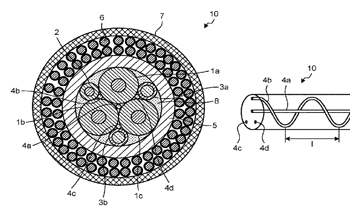
The present disclosure relates to a submarine cable in which cross-wound directions and cross-wound pitches of a metal wire and a shielding member surrounding an outer side of the metal wire that constitute a metal shielding layer of the submarine cable are optimized to minimize damage to the metal shielding layer, to enable rapid energization in the event of an accidental current and further to enhance flexibility by varying the cross-wound pitch of at least one of the metal wire and the shielding member that constitute the metal shielding layer according to an environment in which the submarine cable is laid.
Conductive Outer Jacket for Wireline Cable
US Patent 12,706,230
Published August 11, 2026
Inventors: Joseph Varkey, Richmond, TX, USA; Serko Sarian, Houston, TX, USA; Qingdi Huang, Sugar Land, TX, USA; and Tam Tran, Sugar Land, TX, USA
Assignee: Schlumberger Technology Corporation, Sugar Land, TX, USA
A cable containing a conductive outer layer and methods for manufacturing the conductive outer layer and the cable are provided. A cable may include a cable core and a plurality of armor wire strength members that surround the cable core. The cable may also include a conductive outer layer disposed about the plurality of armor wire strength members that physically contacts at least one armor wire strength member of the plurality of armor wire strength members.
Cable System
US Patent 12,706,232
Published August 11, 2026
Inventors: Michael Ainger, London, England; Michael Dixon, London, England; Nathan Kelly, London, England; and David Stockton, London, England
Assignee: Landways Management Limited, London, England
The invention provides a cable for power distribution and/or data transmission, the cable comprising a core comprising one or more metallic conductors and a sheath surrounding the core, the sheath being formed from a polymer having a tensile modulus of at least 1.5 GPa, wherein the outside diameter of the sheath is no more than 13.5 mm and the stiffness of the cable is at least 0.01 Nm². Advantageously, embodiments of the cable can be readily blown and pushed through a microduct without deforming.
Electrical Cable and Manufacturing Thereof
US Patent 12,706,233
Published August 11, 2026
Inventors: Richard L. Andersson, Kista, Sweden; Magnus Israelsson, Åkersberga, Sweden; and René Suchantke, Hoppegarten, Germany
Assignee: Habia Cable Aktiebolag, Upplands Väsby, Sweden
Low-loss lightweight high-power kilohertz alternating-current high-voltage electrical cables 1 usable in low pressure having a bundle 2 of metallic wires 3 being separated from each other by non-conductor layers 4 provided on the individual metallic wires, wherein the metallic wires 3 alternate between outer positions 5 and inner positions 6 in the bundle along a longitudinal extension 7 of the electrical cable in order to counteract skin effect in the electrical cable bundle 2, as well as enabling counteraction of proximity effect, when in use, an inner semi-conductive layer 8 of broad range temperature rated polymeric material surrounding said bundle 2 of metallic wires 3 and an insulating layer 9 of broad range temperature rated polymeric material surrounding and bonded to the inner semi-conductive layer 5, at least one of the metallic wires 3 being in electric contact with the inner semi-conductive layer 8 as well as a manufacturing method.
Multicore Cable-Having a Stranded Pair of Core Electric Wires and an Adjacent Wire with a Controlled Diameter Ratio
US Patent 12,706,229
Published August 11, 2026
Inventors: Shigeyuki Tanaka, Osaka, Japan; Yutaka Matsumura, Osaka, Japan; Yoshitaka Ogasawara, Osaka, Japan; Naoshi Yokoyama, Osaka, Japan; and Takumi Ooshima, Kanuma, Japan
Assignee: Sumitomo Electric Industries, Ltd., Osaka, Japan
A multicore cable includes a first core wire and a first sheath layer disposed around the first core wire. The first core wire is composed of a pair of first core electric wires and a wire that are stranded together. Each first core electric wire includes a first conductor and a first insulating layer covering an outer surface of the first conductor. In one configuration, the wire is a stranded core electric wire including a second core wire and a second sheath layer disposed around the second core wire, the second core wire being composed of a plurality of third core electric wires that are stranded together, each third core electric wire including a third conductor and a third insulating layer.
Snap-Together Reel With Reinforced Tab
US Patent 12,703,600
Published August 11, 2026
Inventor: Christopher Nichols, Englewood, OH, USA
Assignee: Vandor Corporation, Richmond, IN, USA
A reel includes a core having a first end region defining a plurality of slots, a first flange and a plurality of latching arrangements configured to, in a connected state, connect the first end region of the core to the first flange. Each respective latching arrangement includes a latch arm having a latching projection that, in the connected state, is arranged in an associated slot of the plurality of slots and a support member that, in the connected state, supports the latch arm on a side of the latch arm opposite the latching projection so as to disable the latching projection from moving out of the associated slot.
Charging Cable for an Electric Vehicle with Communication Capability
US Patent 12,695,006
Published July 28, 2026
Inventors: Gertjan Koolen, Eindhoven, Netherlands; Cristoforo La Rosa, Toscana, Italy; Lars Bech, Schiedam, Netherlands; Miguel Rodriguez Escude, Schiedam, Netherlands; Jim van-der-Heijden, Eindhoven, Netherlands; and Stefan Raaijmakers, Delft, Netherlands
Assignee: ABB E-Mobility B.V., Delft, Netherlands
A charging cable for an electric vehicle includes at least two power lines configured for conducting a charging current and two high-frequency communication lines being separate and extending in parallel to the power lines and configured for transmitting a charging information between a charger and an electric vehicle.
Aluminum Bonding Wire for Power Semiconductor
US Patent 12,692,576
Published July 28, 2026
Inventors: Shuichi Mitoma, Saga, Japan; Tsukasa Ichikawa, Saga, Japan; Tsuyoshi Uraji, Tokyo, Japan; Tatsunori Yanagimoto, Tokyo, Japan; and Dai Nakajima, Tokyo, Japan
Assignees: Tanaka Electronics Co., Ltd., Saga, Japan; and Mitsubishi Electric Corporation, Tokyo, Japan
An aluminum wire with which, at the time of bonding a bonding wire for a power semiconductor, the wire is not detached from a wedge tool and a long life is achieved in a power cycle test. The aluminum wire is made of an aluminum alloy having an aluminum purity of 99 mass % or more and contains, relative to a total amount of all elements of the aluminum alloy, a total of 0.01 mass % or more and 1 mass % or less of iron and silicon. In a lateral cross-section in a direction perpendicular to a wire axis of the aluminum wire, an orientation index of is 1 or more, an orientation index of is 1 or less and an area ratio of precipitated particles is in a range of 0.02% or more to 2% or less.
Metal Wire and Metal Mesh
US Patent 12,691,674
Published July 28, 2026
Inventors: Tomohiro Kanazawa, Osaka, Japan; Kazuhiro Daijo, Osaka, Japan; Kenshi Tsuji, Osaka, Japan; Naoki Kohyama, Osaka, Japan; and Yui Nakai, Osaka, Japan
Assignee: Panasonic Intellectual Property Management Co., Ltd., Osaka, Japan
A metal wire includes tungsten or a tungsten alloy. The metal wire has a diameter of at most 13 μm, a tensile strength of at least 4.8 GPa and a natural hanging length per 1000 mm of at least 800 mm.
Integrated Cable Processing Device
US Patent 12,695,279
Published July 28, 2026
Inventors: An (Joshua) Yang, Shanghai, China; and Lvhai (Samuel) Hu, Shanghai, China
Assignee: Tyco Electronics (Shanghai) Co., Ltd., Shanghai, China
An integrated cable processing device for performing processing operations on a cable includes a frame defining a workbench and a plurality of cable processing mechanisms provided on the workbench for performing different processing operations on the cable. A cable clamping assembly of the device is adapted to clamp the cable and is movable relative to the plurality of cable processing mechanisms to successively move a sub segment to be processed of the clamped cable to each of the plurality of cable processing mechanisms and each cable processing mechanism performs the corresponding processing operation on the sub segment.
Cable Sleeve Comprising a Deformable Portion With Variable Cross-Sectional Area
US Patent 12,695,281
Published July 28, 2026
Inventors: Michał Cieszyński, Cracow, Poland; Tomasz Ślizowski, Cracow, Poland; Wojciech Leśniak, Cracow, Poland; and Marek Manterys, Cracow, Poland
Assignee: Aptiv Manufacturing Management Services GmbH, Schaffhausen, Switzerland
The present disclosure relates to cable sleeve for receiving one or more cables, such as a harness for a vehicle. The sleeve includes a sleeve body having a portion made of deformable material. The portion is designed to have a first configuration, which is predefined and to adopt a second configuration. In the first configuration the cross-sectional area of the portion is smaller than in the second configuration. Additionally, In the first configuration the perimeter length of the cross-sectional area is larger than or equal to the second configuration.
Polymer Compositions for Forming an Enamel Coating on a Wire
US Patent 12,686,790
Published July 21, 2026
Inventors: Edward Asirvatham, Chatham, NJ, USA; and Karttikay Moudgil, Johns Creek, GA, USA
Assignee: AdvanSix Resins & Chemicals LLC, Parsippany, NJ, USA
The present disclosure provides for a coating composition for forming a coating on a wire. The coating composition includes a polyamide-imide resin, a polyimide resin, a polyesterimide resin or any two or more of these resins and one or more caprolactam-derived solvents. The present disclosure also provides for a method of producing a coating composition for forming a coating on a wire. The method includes providing a polyamide-imide resin, a polyimide resin, a polyesterimide resin or any two or more of these resins and one or more caprolactam-derived solvents and mixing the polyamide-imide resin, the polyimide resin, the polyesterimide resin or the two or more of these resins and the one or more caprolactam-derived solvents until the polyamide-imide resin, the polyimide resin, the polyesterimide resin or the two or more of these resins is in solution with the one or more caprolactam-derived solvents to produce the coating composition.
Optical Fiber Cable
US Patent 12,687,688
Published July 21, 2026
Inventors: Okimi Mukai, Sakura, Japan; Ken Osato, Sakura, Japan; and Akira Namazue, Sakura, Japan
Assignee: Fujikura Ltd., Tokyo, Japan
An optical fiber cable includes optical fibers, a wrapping tube that wraps around the optical fibers and contacts outermost ones of the optical fibers and a sheath that covers the wrapping tube and has recesses on an inner circumferential surface of the sheath. The recesses are recessed toward a radially outer side of the optical fiber cable such that a space exists between the wrapping tube and the sheath in each of the recesses.
Method for Producing Coaxial Cables Having a Thin-Walled, Radially Closed Outer Conductor
US Patent 12,683,042
Published July 14, 2026
Inventors: Ralf Egerer, Hannover, Germany; Olaf Petersen, Hannover, Germany; and Steven Dinkel, Hannover, Germany
Assignee: Nexans, Courbevoie, France
A method for the continuous production of coaxial cables (224) having a thin-walled, radially closed outer conductor of nonferrous metal comprises supplying a flat strip of the nonferrous metal to a shaping apparatus (212), wherein the thickness of the strip corresponds to the wall thickness of the coaxial cable. The shaping apparatus is configured to continuously shape the supplied flat strip into a form corresponding to the outer conductor of the coaxial cable and around a cable core supplied before the outer conductor is closed. After the shaping, two opposite edges of the flat strip lie flush against one another in a contact region and are continuously welded to one another by a welding apparatus (216) by means of a laser, which radiates light having a wavelength smaller than 600 nm. The laser heats a point in a welding region that has a diameter smaller than 20% of the cross-sectional dimension of the coaxial cable. The welded coaxial cable is drawn off from the welding region and, after introducing a parallel or helical corrugation, is received in a receiving device (226).
Cable
US Patent 12,683,040
Published July 14, 2026
Inventors: Stefan Hilsenbeck, Steinenbronn, Germany; and Werner Körner, Berlin, Germany
Assignee: Lapp Engineering AG, Cham, Switzerland
A cable, in particular a cable for the at least partial transmission of electrical energy, comprising several, in particular three, phase cores and at least one further core, in particular a protective core, is proposed, wherein the several phase cores are stranded to form at least one phase bundle and the at least one further core runs outside the at least one phase bundle in the cable.
Wiring Harness and Electrical Assembly Having a Wiring Harness
US Patent 12,683,039
Published July 14, 2026
Inventors: Maximilian Rosenberger, Munich, Germany; and Thomas Spiess, Munich, Germany
Assignee: Bayerische Motoren Werke AG (BMW AG), Munich, Germany
A wiring harness and an electrical assembly in which a chamber can be vented by the wiring harness are provided. The wiring harness is configured to transmit electrical power between two electrical contact points located separate from each other. The wiring harness includes an individual conductor, which includes an electrically insulating layer and forms, along a longitudinal direction of extent of the wiring harness, two connection ends of the wiring harness for electrically contacting the contact points; a hollow channel element, which is separate from the individual conductor and runs along the longitudinal direction of extent, wherein each of the ends of the channel element opens out at a respective connection end; and a wiring harness sheath, by way of which the individual conductor and the channel element are jointly sheathed along the longitudinal direction of extent.
Polypropylene Composition for Cable Insulation
US Patent 12,674,052
Published July 7, 2026
Inventors: Katja Klimke, Linz, Austria; Per-Ola Hagstrand, Stenungsund, Sweden; Ulf Nilsson, Stenungsund, Sweden; Thomas Gkourmpis, Stenungsund, Sweden; Lars Efraimsson, Stenungsund, Sweden; Anette Johansson, Stenungsund, Sweden; Jingbo Wang, Linz, Austria; Kristian Dahlén, Stenungsund, Sweden; and Gerhard Hubner, Linz, Austria
Assignee: Borealis AG, Vienna, Austria
The present invention relates to a cable comprising at least one layer comprising a polypropylene composition comprising (A) from 80.0 to 99.0 wt.-%, preferably from 82.5 to 97.2 wt. %, most preferably from 85.0 to 95.0 wt.-% of a copolymer of propylene and comonomer units selected from ethylene and alpha-olefins having from 4 to 12 carbon atoms having a total amount of comonomer units of from 10.0 to 16.0 wt %, preferably from 11.0 to 15.0 wt %, most preferably from 12.0 to 14.0 wt %, based on the total amount of monomer units of the copolymer of propylene (A); a melt flow rate MFR2 of from 0.5 to 2.5 g/10 min, preferably from 0.8 to 2.3 g/10 min, still more preferably from 1.0 to 2.0 g/10 min and most preferably from 1.2 to 1.7 g/10 min; a xylene cold soluble (XCS) fraction in a total amount of from 25.0 to 50.0 wt %, preferably from 27.5 to 45.0 wt %, more preferably from 30.0 to 42.5 wt % and most preferably from 32.5 to 40.0 wt %, based on the total weight amount of the copolymer of propylene (A); and (B) from 1.0 to 20.0 wt.-%, preferably from 2.5 to 17.5 wt %, most preferably from 5.0 to 15.0 wt.-% of a propylene polymer having a density of from 855 to 890 kg/m, preferably from 860 to 885 kg/m3, mot preferably from 865 to 880 kg/m3.
Cable Substitute for Mineral-Insulated Cables in Nuclear Facilities
US Patent 12,676,250
Published July 7, 2026
Inventor: Eric Jason Rasmussen, West Hartford, CT, USA
Assignee: RSCC Wire and Cable LLC, East Granby, CT, USA
An electrical cable for use as a substitute for mineral-insulated cables in nuclear facilities is described herein. The cable may include at least one conductor, insulation, a jacket and an armor shell. In some embodiments, the conductor may comprise a stranded conductor of one of various grades. The insulation may comprise phlogopite or muscovite mica tape that may be helically or longitudinally applied in overlapping concentric layers around at least one conductor. The jacket may comprise a woven glass braid applied over insulation surrounding one or multiple conductors. The armor may comprise hermitically sealed metallic armor applied around the other components of the cable, thereby forming an exterior of the cable. The inorganic materials utilized may be configured to limit the creation of adverse and/or undesirable elements instigated by transmutation from neutron irradiation exposure.
Resin Composition and Power Cable
US Patent 12,668,692
Published June 30, 2026
Inventors: Satoshi Yamasaki, Osaka, Japan; Fumitoshi Iyoda, Osaka, Japan; and Takanori Yamazaki, Osaka, Japan
Assignee: Sumitomo Electric Industries, Ltd., Osaka, Japan
A resin composition, including: a resin component containing propylene units and a resistance-imparting agent, wherein the resistance-imparting agent is a monomer having a phenol skeleton with hydrogen or an alkyl group having 1 to 3 carbon atoms, bonded to at least one of ortho positions to the hydroxyl group of the phenol skeleton and has a melting point of 215°C. or less and a molecular weight of 200 or more and 500 or less, a content of the resistance-imparting agent is 0.4 parts by mass or more and 10 parts by mass or less with respect to 100 parts by mass of the resin component and a content ratio of metal impurities is 0.02% by volume or less.
Niobium-Aluminum Precursor Wire, Niobium-Aluminum Precursor Twisted Wire, Niobium-Aluminum Superconducting Wire and Niobium-Aluminum Superconducting Twisted Wire
US Patent 12,671,014
Published June 30, 2026
Inventors: Akihiro Kikuchi, Tsukuba, Japan; Yasuo Iijima, Tsukuba, Japan; Masaru Yamamoto, Chuo, Japan; Masatoshi Kawano, Chuo, Japan; and Masato Otsubo, Tokyo, Japan
Assignees: National Institute for Materials Science, Ibaraki, Japan; and Japan Superconductivity Application Development Inc., Kanagawa, Japan
The purpose of the present disclosure is to provide a niobium-aluminum precursor wire having properties such as expression of flexibility and ensuring a large single-wire length, as well as a twisted wire, a superconducting wire and a superconducting twisted wire formed of the niobium-aluminum precursor wire. The present disclosure provides a niobium-aluminum precursor wire and a twisted wire using the same, the niobium-aluminum precursor wire including: a rod-like winding core (5) formed of a stabilized copper or a stabilized copper and an unstabilized copper; a laminated body (3) that is wound around the winding core (5) and that is formed of an aluminum foil and a niobium foil laminated one on the other; and a covering body (1) that covers the circumference of the laminated body and that is formed of a stabilized copper or a stabilized copper and an unstabilized copper.
Profile Wire Conductor and a Power Cable
US Patent 12,671,011
Published June 30, 2026
Inventors: Kristian Gustafsson, Karlskrona, Sweden; and Tommy Johansson, Bräkne-Hoby, Sweden
Assignee: NKT HV Cables AB, Lyckeby, Sweden
A profile wire conductor for an electric power cable has a central longitudinal axis and includes stranded individual profile wires arranged in concentric wire layers around the central longitudinal axis. The concentric wire layers include an inner wire layer of profile wires of a first type having a first radial cross sectional geometry and an outermost wire layer of profile wires forming an outer surface of the profile wire conductor. At least one of the profile wires in the outermost wire layer is of a second type and has a second radial cross sectional geometry being different to the first radial cross sectional geometry. The profile wires of the second type form an indentation or protrusion in the outer surface of the profile wire conductor.